Automating CRE Due Diligence Checklists with AI
AI cuts lease review from weeks to hours, surfacing deal risk faster.

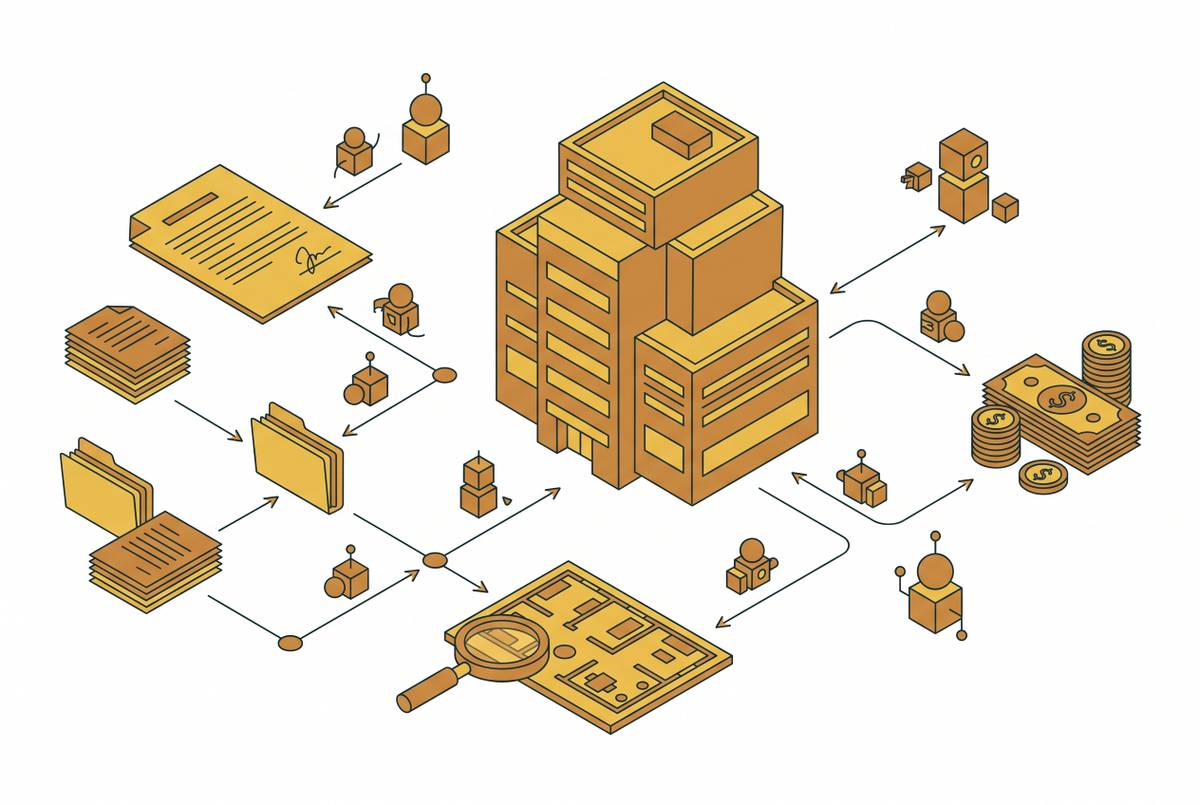
A commercial lease stack that took an analyst a full week to abstract now clears a first pass in a few hours. AI is turning a standard CRE due diligence checklist into something an agent actually runs: pulling numbers out of financial statements, checking lease terms against rent rolls, flagging title exceptions, and handing a deal team a structured output instead of a stack of PDFs. This piece walks through the major categories of a standard CRE due diligence checklist, financial review, property analysis, legal documentation, market evaluation, operational risk, and matches each to the AI workflow now doing that work.
The stakes aren't abstract. A CMBS pool or a bridge loan file can run thousands of pages: title reports, environmental assessments, lease abstracts, rent rolls, operating statements. One discrepancy buried in that pile, a missed escalation clause, a rent roll figure that doesn't match the T-12, can shift underwriting by real money. Deal volume adds pressure on top of that. The Mortgage Bankers Association reported $498 billion in total CRE lending in 2024, up 16% year-over-year, and forecasts originations reaching $805 billion in 2026. More deals, same headcount.
A single commercial lease still takes four to eight hours to abstract by hand, and manual extraction of dates, financial terms, and complex clauses runs error rates of 10% or higher. At deal scale, that isn't a rounding error. It's the mistake that surfaces in a credit committee memo three weeks later, after the underwriting has already been built on top of it.
The gap between AI interest and AI execution across the CRE industry
Nearly every firm in commercial real estate says it's working on AI. Almost none of them have anything to show for it, and that gap is the real story. JLL's 2025 Global Real Estate Technology Survey found that 88% of CRE investors and owners have started AI pilots. Only 5% report hitting most of their AI program goals. Everything else sits in that gap between the two numbers.
Most firms treat AI as something to run in a sandbox next to the real workflow, and that's the wrong approach: a pilot that never touches the process never touches the hours anyone actually spends. Industry research has consistently named underwriting and document review as the highest-priority areas for AI investment, and that's not a coincidence. Those are the two places firms already know they're bleeding time. A July 2025 survey of North American banks found only 12% had deployed any gen AI use cases at all, which means the firms that move first on the actual workflow, not the pilot, get the head start.
Whether a firm has an AI pilot running somewhere in an innovation group doesn't matter much heading into 2026. What matters is whether AI sits inside the workflow that decides if a deal closes on time. The firms closing the gap are doing it checklist item by checklist item, not by bolting a general-purpose chatbot onto an existing process and calling it done.
How AI agents handle the financial review layer of due diligence
Financial review covers operating statements (T-12s), rent rolls, borrower financials, NOI validation, and expense normalization. The manual version has an analyst retyping figures from a rent roll into a spreadsheet, then retyping figures from a T-12 into that same model. That retyping is where inconsistency creeps in, and where downstream errors get born.
AI spreading tools now handle the mechanical layer directly. An agent ingests offering memoranda, rent rolls, T-12s, and leases, pulls the relevant figures, and produces a first-pass analysis. It separates recurring income and expense items from nonrecurring ones, a normalization step generic document tools tend to skip and one that matters enormously for NOI accuracy. Every extracted line carries a source citation, so an underwriter can trace a number back to the page it came from instead of trusting a black box. The system also keeps a log: data inputs, changes, exceptions, approvals, all recorded, so risk teams have a record of how a figure was reached, not just what it turned out to be. None of this settles pricing or credit questions on its own. The agent flags; a person decides.
The numbers back the shift. Freddie Mac's May 2025 analysis found lenders maximizing AI-enabled underwriting achieve up to 40% cost savings in loan processing, roughly $1,500 per loan, with a production cycle five days shorter than the manual baseline. Moody's QUIQspread tool delivers accuracy above 95% on completed spreads, and Nedbank now runs more than 90% of its borrower financials through automated spreading.
None of this removes the analyst from the loop. The analyst still checks every source input, owns the underwriting model, runs the scenarios, and makes the final call on credit or investment. What changes is where the hours go: extraction and normalization move to the machine, judgment stays with the person. Purpose-built CRE financial AI matters here because it's trained on the document structures this industry actually uses, rent rolls, DSCR templates, ARGUS outputs, instead of treating every financial PDF the same way a generic spreading tool would.
What AI agents do when they read a lease stack
A single commercial lease takes four to eight hours to abstract by hand. A multi-tenant acquisition might involve dozens of leases; an institutional portfolio review can involve thousands. At that scale, manual abstraction is the single biggest bottleneck between signing a letter of intent and closing.
AI agents do three distinct jobs on a lease stack. First, abstraction: pulling terms, dates, renewal options, escalations, tenant improvement obligations, and maintenance responsibilities out of PDFs and into structured, queryable tables. Second, cross-document reconciliation: checking the rent roll against the leases against the offering memo, and surfacing where they disagree, which is usually where the real deal risk hides. Third, completeness checking: flagging what's missing from the data room against the diligence checklist, so a gap gets caught during the review window instead of after closing.
The mechanics combine a few technical approaches. Machine learning models identify document types, natural language processing pulls clause-level terms, and computer vision handles scanned or non-native PDFs that don't have clean, extractable text. Purpose-built lease abstraction platforms extract lease terms, financial data, and key dates at high accuracy, and integrate with existing systems to auto-populate underwriting models directly. Because an agent can process a rent roll, an operating statement, and a set of lease abstracts at the same time rather than one after another, the review compresses in a way sequential human reading never can.
The reconciliation output is what actually changes decision-making. Instead of an analyst holding three documents side by side and hunting for mismatches, the agent surfaces only the places where the numbers don't line up, so attention goes where it belongs. Say it plainly: the real gain is speed applied to the one step, cross-checking, where human attention was always stretched thinnest.
How AI handles environmental and property condition review
This category covers Phase I environmental site assessments, property condition reports, zoning verification, flood and hazard data, and ADA compliance flags. It's also the category where AI's role is narrowest, by design, not by any shortcoming in the technology.
Agents can scan environmental databases and reports to identify potential contamination, hazardous waste sites, underground storage tanks, and known spill records, and check regulatory compliance status across jurisdictions, flagging possible violations for review. They can ingest a property condition report and pull the flagged items, deferred maintenance, structural observations, MEP deficiencies, into a prioritized summary. They can cross-reference zoning data and flood zone designations from public databases against a property's address and legal description.
Here's where the line holds firm, and it should hold firm: physical inspection by a licensed engineer isn't something software replicates. The agent summarizes what a report says; the inspection itself still needs a person on site. The call to move from Phase I to Phase II testing needs a qualified environmental professional making a determination the agent can flag but never make. In practice, the agent ingests the Phase I report, extracts recognized environmental conditions and de minimis conditions, flags anything that might need Phase II follow-up, and delivers a structured summary instead of a sixty-page PDF for someone to read cover to cover. The review cycle gets shorter without skipping past the licensed expertise regulators and lenders actually require.
Market evaluation as a real-time data workflow, not a static comp pull
Market evaluation covers submarket vacancy and absorption, rent growth trajectories, comparable sales and cap rate ranges, demographic overlays, and supply pipeline data. The old version had a broker pulling comps by hand and an analyst dropping them into the market section of the offering memo; by the time that section got assembled, it was already looking backward.
AI agents replace that static pull with something closer to a live feed: real-time comparables, rent forecasts, and demographic overlays drawn from current data rather than a snapshot from last quarter. Supply pipeline data gets checked against the subject property's submarket and lease expiration schedule automatically, producing in minutes what used to take analysts weeks to compile by hand.
The output is only as good as what feeds it, and that's worth being blunt about: a generic AI tool pointed at a stale third-party feed produces a worse memo than a human analyst working off a phone call to a local broker. The AI label means nothing without knowing what data sits behind it. Purpose-built CRE platforms with proprietary, real-time data close that gap; Industry forecasters broadly identify AI and data analytics among the top strategic priorities for CRE firms heading into the next cycle, and market intelligence is exactly where that priority shows up in a diligence file. Still, no dataset captures a landlord's informal reputation in a submarket, a neighborhood shift that hasn't shown up in the numbers yet, or a tenant's unannounced plan to relocate. Local broker judgment and direct tenant conversations stay irreplaceable for that reason, and no amount of data pipeline changes it.
Legal and title review: what agents flag before attorneys engage
Legal documentation review covers title commitments and exceptions, survey review, easements and encumbrances, entity formation documents, loan documents, and SNDA and estoppel certificates. This is a category where AI's job is triage, and the line between triage and judgment is unusually clean.
Agents can ingest title commitments and pull Schedule B exceptions into a structured list ranked by how much each one matters. They can flag exceptions that fall into standard high-risk categories, mechanics' liens, unresolved judgments, access easement problems, for immediate attorney attention. They can pull terms from estoppel certificates and check them against the lease abstract, surfacing the gap between what a tenant certified and what the lease actually says. They can review entity formation documents to confirm signing authority, checking signatories against operating agreement provisions and required approvals. They can check loan document drafts against the term sheet, flagging deviations before the redline process even starts.
What stays with the attorney is interpretation: whether a title exception is curable, whether it's enforceable, whether it kills the deal or just gets insured over. The agent presents the exception; counsel decides what it means. That division produces a real productivity gain, since the attorney spends time on the exceptions that matter instead of reading every line of a Schedule B from scratch. On institutional deals running thousands of pages of title reports, that's the difference between counsel reviewing forty flagged exceptions and counsel reading four hundred pages to find them.
How AI agents produce the review-ready outputs that close the diligence loop
Reviewing each category well doesn't finish the job. At some point the findings have to become a document a lender, an investment committee, or a partner can actually act on, and that synthesis step has historically been just as slow and just as error-prone as the review itself.
AI agents now produce that output directly. Loan packages and credit memos pull structured data from the spreading, lease abstraction, and market intelligence workflows into a formatted narrative, source citations intact throughout. OM review summaries pull the key performance metrics, cap rates, NOI, occupancy, lease expiration schedules, tenant profiles, price per square foot, out of dense offering documents into a digest an investment committee can read in one sitting. Diligence gap reports track checklist status in real time: what's complete, what's pending, what's still missing from the data room as documents arrive. The audit trail persists throughout, giving risk leaders a full record of inputs, normalizations, exceptions, and approvals.
Offering memoranda are notoriously dense, and reading one by hand is a genuine bottleneck on most deal teams. AI-assisted OM review turns that document-reading task into a structured data-extraction task. CBRE's 2025 Tech Adoption Report found development teams using AI for underwriting completed preliminary analysis three times faster than teams working without it, and the output stage is exactly where that speed becomes visible to whoever makes the final call. A patchwork of point solutions loses something at every handoff: formatting breaks, a figure gets dropped, a citation goes missing. Platforms that put spreading, document review, market data, and memo generation on one system tend to produce more consistent output for that reason. Lev, which combines real-time CRE data with AI agents built for deal workflows, is one platform built around that logic, building the extraction accuracy and audit trail institutional deals require directly into its spreading and underwriting product rather than bolting it on afterward. The memo or loan package is the artifact the committee actually sees; AI that runs through the whole diligence cycle and produces that final document closes the loop, instead of leaving synthesis as one more manual task at the end.
Where human judgment remains load-bearing in an AI-assisted diligence process
None of this makes the analyst, the attorney, or the licensed engineer optional. Anyone selling full automation in this space is selling something the technology doesn't support, and that claim deserves to be dismissed outright rather than debated. AI agents handle extraction, normalization, reconciliation, and first-pass flagging across every category of the diligence checklist, but the decisions that determine whether a deal closes still sit with people: the underwriter who owns the model and tests the scenarios, the attorney who decides whether a title exception is curable, the engineer who actually walks the site.
That split reflects where judgment genuinely needs a person with context, training, and legal or professional accountability, none of which a language model carries. The firms narrowing the gap between AI pilots and AI execution aren't chasing full autonomy. They've worked out exactly where the line sits between what an agent should flag and what a human has to decide, and they've built their workflow around that line instead of around the promise of the technology.