What AI Agents Actually Do Inside a Commercial Real Estate Deal
Agents handle CRE's document work, freeing brokers for relationships.
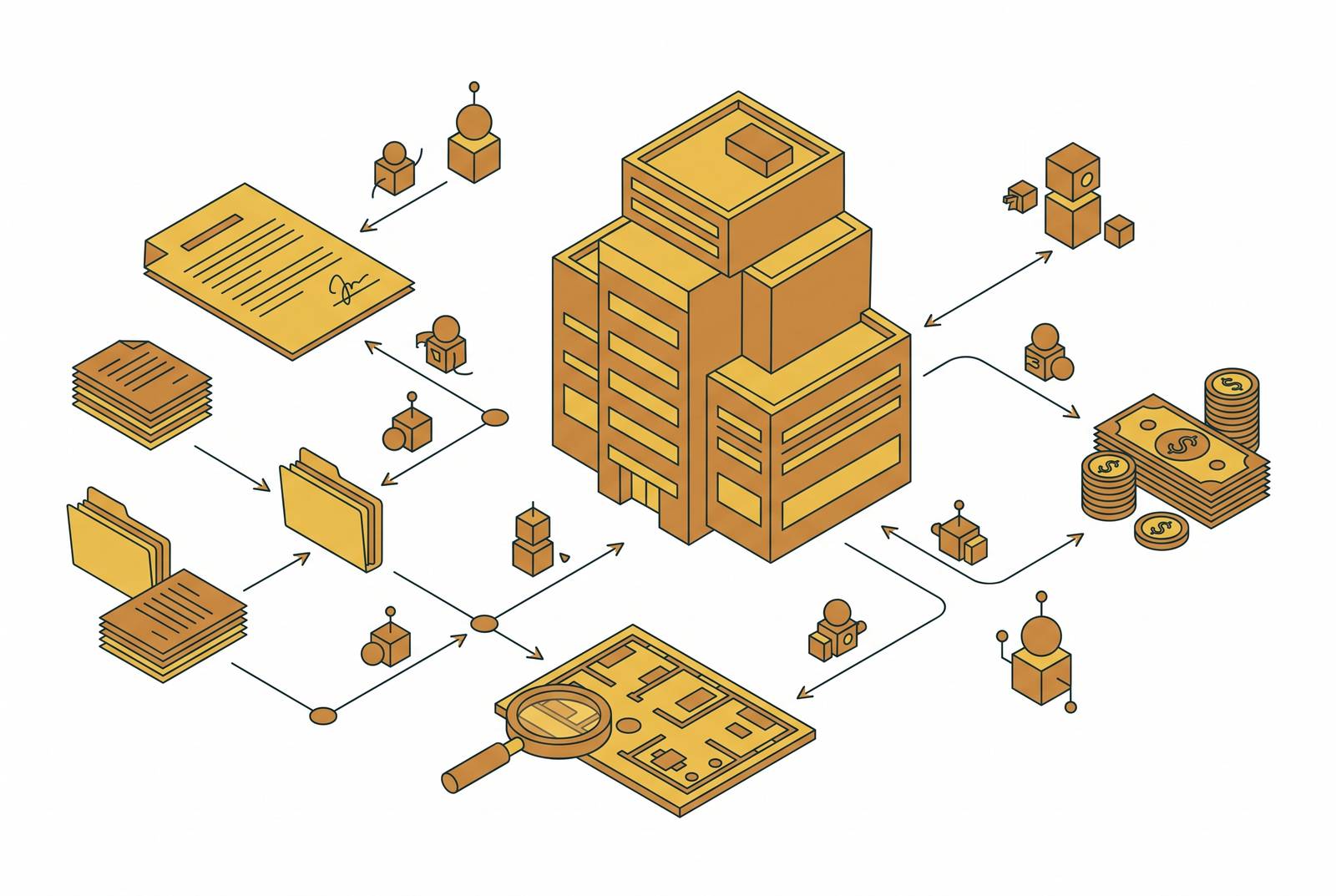
Most conversations about AI in commercial real estate still treat the category as one thing: chatbots that draft emails, summarize leases, or answer questions when asked. That framing misses the category that actually changes deal economics, AI agents configured to run a multi-step workflow on their own and surface finished output for a human to approve. Confusing the two is why so many CRE professionals underestimate what's already deployable today.
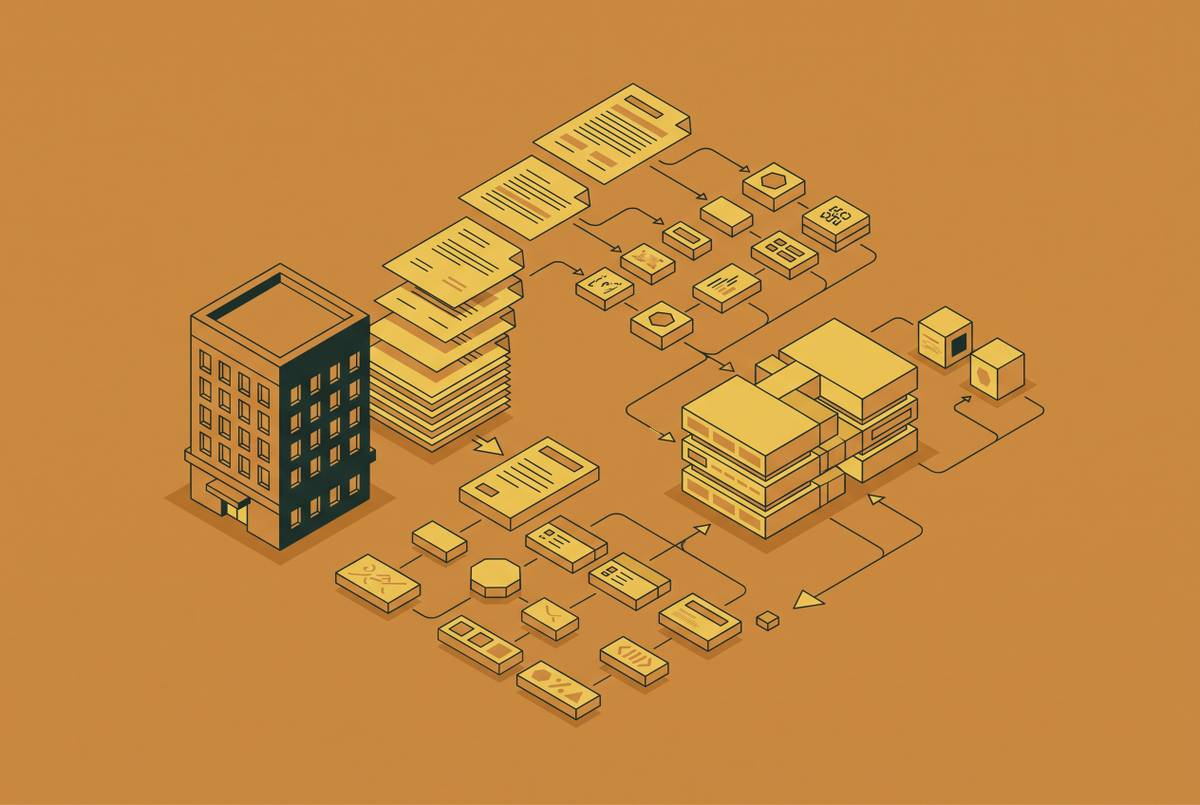
An agent set up this way doesn't wait for a prompt at every step. It runs the same loop across a defined process, and it only stops to hand a person a decision point. CRE is built for exactly this kind of automation: offering memoranda, rent rolls, T-12s, leases, market reports, and financial statements move through every stage of a deal, and the process around them is repetitive in ways that document-dense industries tend to be.
People often object that CRE depends too heavily on relationships and judgment for software to touch, but this misunderstands where agents actually operate. They take over the document-heavy, calculation-heavy work that surrounds a deal. That division of labor, as SFA iLabs puts it, is the whole game: agents don't replace the broker who gets the call before the OM goes wide, they replace the hours spent re-keying a rent roll into a model after the call comes in. The sections that follow walk that division through five stages of a deal, from first signal to LP report, to show exactly where that labor gets absorbed.
What a deal-sourcing agent monitors and decides
Sourcing is the stage where it's easiest to overstate what an agent does, so the job it actually performs is tracking signals and flagging matches, not deciding them. A deal-sourcing agent tracks public signal sources, permit filings, deed-recording events, assessed-value changes, distress indicators, across large sets of properties at once, and it runs inbound OMs against a firm's acquisition criteria so a matching opportunity can get flagged before the broker blast even lands in a shared inbox. On the prospecting side, the same kind of system weighs ownership duration, upcoming debt maturities, property tax assessment changes, permit activity that points to deferred maintenance, and shifts in the local market, then scores potential sellers by how likely they are to transact, a process The AI Consulting Network has documented in detail.
None of that is new analytical work. It's the same kind of evaluation an analyst already does, run across far more properties than one person could track by hand. The checkpoint that matters here is the shortlist review: the agent surfaces and ranks opportunities, and a person still decides who gets the call. Sourcing is also where it's tempting to trust the system past what it can deliver. An agent cannot create deal flow that doesn't exist, and it doesn't replace the ownership relationships that still win off-market deals before a listing ever circulates. What it changes is volume. A fully automated pipeline can evaluate far more acquisition targets per week than a team working through spreadsheets by hand, a gap that hiring more analysts cannot close on its own, since the constraint was never headcount so much as how many signals one person can watch at the same time.
Converting a passed deal into a preliminary underwriting model
Once a deal clears that initial screen, the heaviest document work in the pipeline begins, and it's also where agent-driven time compression is most documented. An agent builds a preliminary underwriting model on its own: calculating NOI, projecting a stabilized cap rate against market comps, modeling DSCR at the target leverage ratio, and estimating IRR ranges under base, upside, and downside scenarios, all before an analyst opens a blank spreadsheet.
The slow part of underwriting was always populating the model: extracting rent roll data, mapping line items to the right categories, pulling trailing-actuals out of scanned PDFs, and finding comps that actually match the asset. NextAutomation says its underwriting copilot does this extraction work, so the analyst gets a model that's already built instead of starting from the source documents. On the lending side, Clik.ai reports a 90% reduction in manual data processing time in its own account of the platform, along with high extraction accuracy across operating statements, rent rolls, and other financial documents. Its Bellwether Enterprise case study describes a 24-hour turnaround on complete financial spreading and underwriting workflows, with more than 90 agency, life company, and CMBS underwriting models integrated into the platform, a figure worth reading as what one deployed system reports rather than a fixed industry standard.
The architecture behind these gains matters as much as the output. Financial analysis still contains steps where ordinary software beats generative AI outright: adding numbers, calculating ratios, confirming a balance sheet balances, none of that calls for probabilistic reasoning, and none of it should be left to a model that guesses. So the underwriting agents that hold up under scrutiny are built as hybrids. AI extracts and structures the data, then conventional software runs the calculations, and a verification layer checks the output before a person sees it. The time an analyst saves doesn't come from being cut out of the process. It comes from inheriting a model that's already largely built.
The OM and IC memo: what agents produce from a single document upload
The same extraction capability that pre-fills an underwriting model also drives the documents that move a deal forward internally. A single OM upload can generate three distinct outputs from one agent pass: a structured deal snapshot, a draft IC memo, and an asset business plan, one upload in, three finished artifacts out. The agent pulls deal facts out of raw documents, rent rolls, operating statements, structures them into a consistent format, and produces a formatted memo in minutes rather than the hours that formatting, cross-checking, and recalculating used to take on every deal that crossed a desk.
Lev is one platform built around this kind of document-to-output pipeline: it generates structured deal materials directly from an uploaded OM, so an analyst doesn't have to rebuild the same information by hand in a separate template.
What makes this stage consequential is that nothing downstream corrects for a bad start here. So the IC memo, the lender package, and the eventual LP update all inherit whatever quality got set when documents were first extracted and structured. That cuts both ways: structured intake speeds up every step that follows it, while unstructured intake, a loose pile of inconsistently formatted PDFs, plants errors that compound as the deal moves from memo to lender package to investor update.
Financial spreading and credit analysis as a connected agent workflow, not a one-step tool
On the lending side of a transaction, financial spreading is one stage inside what some platforms describe as an AI credit operating system: document collection, financial spreading, credit analysis, memo preparation, portfolio management, and scoring, all run inside one connected workflow, with specialized agents handling different parts and an orchestration layer deciding what happens in what order. One agent extracts financial information from source documents. Another classifies individual line items. A third drafts the credit memorandum. None of the three is interchangeable with the others, and the orchestration layer sitting above them is what turns three separate tools into one pipeline rather than three disconnected point solutions.
The payoff for a lender is execution speed. Financing decisions that currently take weeks, collecting documents, spreading statements, circulating memos for internal sign-off, can compress substantially under this kind of system, and a lender that can deliver commitment certainty faster competes on more than pricing alone. Execution speed frequently decides whether a commercial transaction closes.
The sharpest challenge to this model is auditability. If a system calculates debt-service coverage, property income, or borrower liquidity, the lender has to be able to point to exactly which financial information produced that number. A model that looks polished is worthless if nobody on the credit committee can prove which file version generated the NOI figure or trace how a non-standard covenant got parsed in the first place. That's no longer a theoretical concern. MISMO, the standards body for the real estate finance industry, launched two AI governance certifications in August 2026 built to help mortgage companies manage responsible AI governance, covering risk assessment, documentation, oversight, and controls. Capital providers are moving past treating this as a convenience question and into treating it as a compliance requirement, which makes auditability a competitive baseline rather than a nice-to-have. If an automated workflow can't show its work, you don't get faster credit decisions. It produces faster errors, with no way to trace where they entered.
Portfolio monitoring and LP reporting: where agents replace the most time-consuming recurring work
The agent's role in a deal doesn't end at closing, and the stages that follow look a lot like underwriting in structure even though they sit on the asset-management side of the business. Variance reviews, comparing budgeted NOI against actual NOI, watching cap rate compression, tracking DSCR coverage across a portfolio, used to take weeks of analyst time. An agent that ingests the underlying fund data can run the same comparison and surface exceptions automatically in a fraction of that time.
LP reporting follows the same logic for a different reason: the output is structured, the underlying workflow repeats every quarter, and the manual version of it is well documented as slow. Drafting quarterly updates, distribution notices, and fund narratives from underlying data through copy-paste and manual formatting consumes many hours per quarter per fund, a cost NextAutomation lays out directly for its LP Reporting Agent. So capital markets teams now apply the same document-extraction and structured-output capability that generates an OM to these recurring investor communications, and update memos and quarterly packages get drafted straight from the underlying fund data.
One development follows from this logic, though it doesn't describe current standard practice everywhere. Instead of relying on annual or periodic reviews, lenders using continuous monitoring agents can track payment behavior, cash flows, and operating performance throughout the life of a loan, so a borrower's risk profile updates as the underlying property changes rather than waiting for the next scheduled review. Under that model, a borrower's deterioration appears earlier, in the continuous monitoring data itself, than a calendar-driven review cycle would catch it.
What the stage-by-stage picture means for CRE adoption
Walking through all five stages points to a conclusion about team structure more than about technology. Agents don't replace the deal team. One analyst ends up covering work that used to need two people, or two analysts run the deal volume that used to need four, so the same team closes more transactions at higher quality instead of a smaller team doing the same volume. GrowthFactor's 2026 guide captures the gap between intent and execution precisely: 88% of CRE investors have started piloting AI, but only a small fraction have hit their program objectives. That gap between experimentation and results is where firms pull ahead, if they move past scattered point tools and into integrated pipeline deployment.
The sequencing that follows from the evidence favors discipline over novelty. The place to start is the workflow already costing the most analyst hours, underwriting document extraction, OM generation, LP reporting, because a process that's already documented is easier to automate, audit, and improve than an open-ended request with no fixed shape, a sequencing AI for CRE Collective recommends directly.
The capital backing this infrastructure suggests investors are treating it the same way. Fifth Dimension's Series A, announced May 11, 2026, was led by HV Capital with backing from Speedinvest, Seedcamp, Anthemis Group, Prudence, Mercia Ventures, MMC Ventures, and AFG Partners. Funding at that scale, behind this kind of architecture, reads as a bet on core infrastructure for the industry rather than a productivity experiment that might not outlast its pilot phase.
The MISMO certifications from August 2026 point the same direction from the regulatory side. Firms evaluating platforms in the next cycle will choose on governance as much as on productivity, so the real test becomes documented data lineage and traceable outputs, not general-purpose tools flexible enough to do anything and accountable for nothing in particular. That's the logic behind building a hybrid architecture in the first place, where AI handles extraction and structuring while conventional software runs the exact calculations and a verification layer checks the result, because that combination is what produces automation a lender or an investment committee can actually trust at scale. Platforms built specifically for CRE, Lev among them, pair real-time data with agents configured around particular underwriting workflows, so the analyst inherits a model that's already substantially complete rather than starting from raw documents and manual extraction on every deal. That's the standard the rest of the industry is now being measured against, because it's the one that holds up when someone asks where a number came from.