Document Automation for CRE Underwriting and Loan Packages
Automating document processing cuts underwriting cycle time and reduces manual data entry errors.

A commercial loan package lands on an analyst's desk as a pile of mismatched files: T-12 operating statements, rent rolls, leases, tax returns, borrower financials, appraisals, some scanned as images, some routed by email as PDFs, some sitting in spreadsheets that follow no shared format. The work that follows is data entry: pulling figures from each document, typing them into an internal template line by line, and checking one source against another when the numbers don't agree. Every one of those handoffs is a place where a deal slows down, where a number gets typed wrong, or where two sources quietly disagree and nobody notices until later. The credit judgment at the end of the process is not where commercial real estate underwriting loses time. The loss happens in the space between the moment documents arrive and the moment an analyst has clean, trustworthy numbers to work with, and that space is where cycle time disappears and errors get written into the model.
That gap matters more now because the demand side of the market has shifted while the supervisory side has not. In January 2026, the Federal Reserve surveyed banks and found that they held CRE lending standards unchanged even as loan demand strengthened. Lenders have to move more deals through underwriting, but they can't loosen the controls that govern those deals, and they aren't adding analysts at the same rate that loan volume is growing. That combination, more throughput and the same scrutiny, is what makes the document-handling gap a business problem rather than an inconvenience. A bank cannot solve it by asking analysts to work faster at the same manual tasks. It has to change what those tasks are.
The four-stage pipeline document automation runs
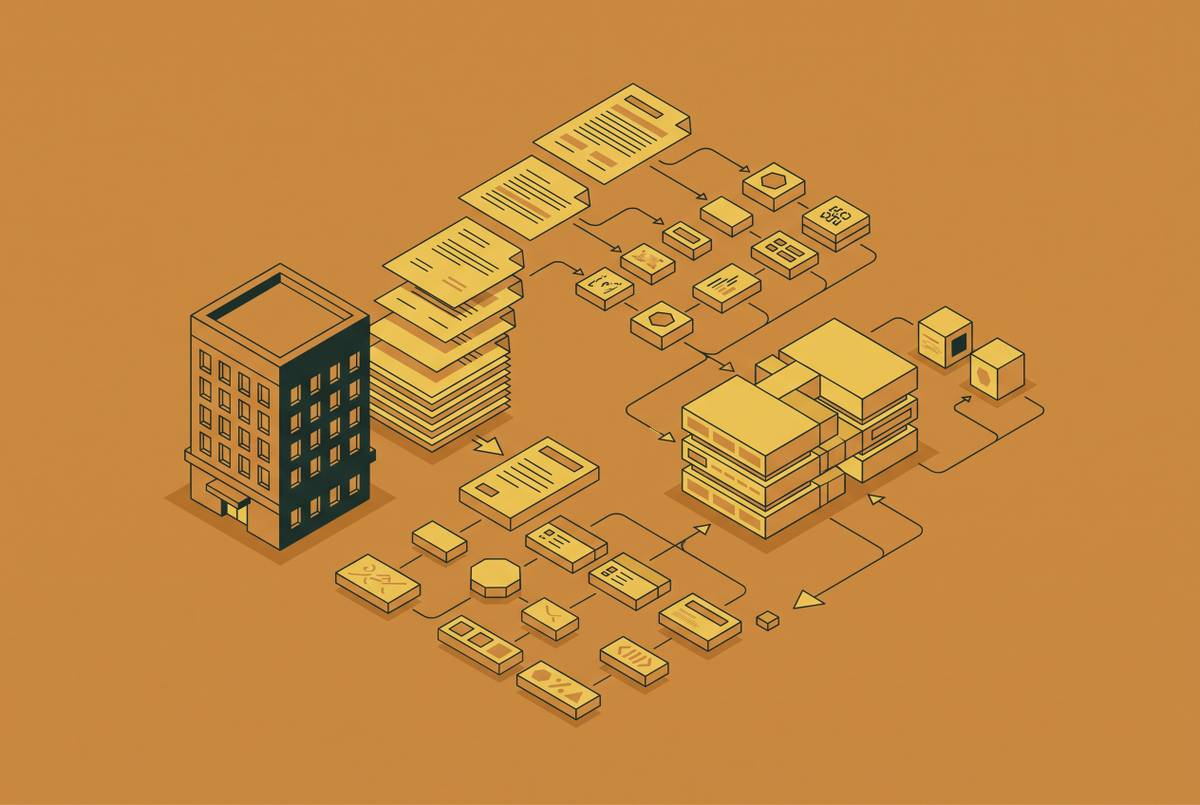
Document automation for CRE underwriting is best understood as a sequence of four stages: ingestion, extraction, normalization, and output. Seeing the pipeline this way gives a practitioner a way to judge any given platform on what it actually does, rather than on how it markets itself.
Ingestion is the first stage, where a system takes in whatever documents a deal produces, regardless of format. Extraction is the second stage, and it's the one most vendors advertise hardest. Here, the platform reads every field a financial model will eventually need: unit count, base rent, escalation schedules, expense line items, occupancy, lease term, renewal options, borrower income, and repayment terms. It pulls these from offering memoranda, T-12s, rent rolls, lease abstracts, and borrower financial statements. If a platform is built natively on AI, rather than bolted onto older rules-based scanning tools, it can read the full range of CRE source documents, and the originating files don't need to follow any standard format.
Normalization and mapping make up the third stage, and it's where raw extracted numbers become usable inputs. Figures pulled from different documents get reconciled against each other, and if any disagree, they get flagged before an analyst ever opens a model.
The fourth stage is output and export, and it is where the design philosophy of a platform shows most clearly. Structured, reconciled data gets written into whatever the firm already uses, its existing financial model, its loan origination system, or its data warehouse. The platforms worth taking seriously feed the model a firm already trusts, so they don't force that firm onto a new, vendor-owned format. What comes out the other end: populated Excel models, calculated DSCR and LTV figures, and exception flags that tell an analyst exactly where to look before signing off.
Why traceability is the minimum bar for institutional-grade extraction
Among all the properties an extraction engine could have, one has become the dividing line between tools that belong in institutional credit work and tools that don't: source traceability, every number in the model links back to the exact page it came from. This has stopped being a nice-to-have feature that distinguishes premium vendors from budget ones. If a platform can't show a reviewer exactly which page produced a given figure, it's now considered inadequate for institutional credit work.
The reason traceability carries this much weight is straightforward: it creates the audit trail that internal compliance review and bank examiners actually need to see. When every extracted value links back to the original borrower document, a reviewer or an examiner can reconstruct how a number got into the model, which is what satisfies an institutional review process rather than just an analyst's say-so. Clik.ai, for example, builds 100% section and page citations into its outputs, so every extracted figure comes with a direct line back to the document it was pulled from. Regulators and lenders have said that automated spreading can satisfy bank examiner requirements, provided the lender keeps an appropriate review and documentation process in place. Traceability is the mechanism that makes that review process defensible rather than theoretical.
There's a practical test that follows from this, and it has nothing to do with a vendor's demo deck. A tool can look flawless on a clean, well-formatted sample deal, but it can still fail badly on the files a firm actually receives. The only honest test is to run a candidate platform against the messiest rent rolls and T-12s a firm has on hand, because that is where traceability either holds together or falls apart.
The security dimension of this deserves one direct sentence rather than a lecture: consumer-grade AI tools fail the traceability bar outright, and using them to analyze proprietary deal data exposes a firm to data security risk and fiduciary liability that risk committees and examiners will not accept. Institutional buyers should expect provenance, immutable audit logs, and zero-data-retention commitments as baseline requirements.
The Three Categories of CRE Underwriting Software
If you buy the wrong category for a given workflow, you don't save work. It creates a gap that someone on staff has to fill by hand, which defeats the purpose of automating in the first place.
The first category covers deal modeling and valuation tools, the platforms that build the pro forma, run scenarios, and value the asset. Cactus and PropRise Primer both take a deal from offering memorandum, T-12, and rent roll straight into the firm's own Excel model, and both trace every number back to its source page. Archer focuses on fast rent roll and T-12 parsing with built-in rent and expense comps, and you get it built for multifamily deals with pipeline tracking. ARGUS Enterprise is still the institutional standard for discounted cash flow modeling and long-term asset valuation. Moraine goes further than underwriting on its own, covering tenant credit scoring with default probability, lease red flag detection, legal and title screening, and CapEx analysis, which suits acquisition teams that want one workflow rather than a standalone underwriting tool. Pro Formance CRE takes a different shape entirely, working as an Excel add-in that processes rent rolls, PDFs, and T-12s and feeds that data into a team's existing Excel-based underwriting workflow, a natural fit for teams already deep in Excel.
The second category is built around lending rather than valuation: origination, credit analysis, financial spreading, and portfolio monitoring for lenders and servicers. Clik.ai automates the spreading of property and loan documents into production-ready outputs, including Excel-based financial models, and handles T-12s, rent rolls, and operating statements. In its deployment at Bellwether Enterprise, the platform produced meaningful time savings on operating statement and rent roll processing, with more than 90 underwriting models integrated into the workflow. MightyBot takes a different angle, enforcing versioned, backtestable credit policy with why-trails tied to FCRA, ECOA, Reg Z, and BSA/AML requirements linked to every decision, and a typical initial deployment runs around 60 days.
The third category covers document extraction tools that feed an existing model or loan system rather than building one themselves: they own the ingestion, extraction, and normalization stages and hand structured output to whatever the firm already runs. Docsumo extracts T-12s, rent rolls, offering memoranda, tax returns, and bank statements, and sends validated data through an API and webhooks directly into a firm's existing model or loan origination system. Fields the system is unsure about get routed to a human reviewer before anything is finalized. Docsumo is explicitly not a loan origination system and does not build the pro forma itself; it is priced through quoted Business and Enterprise plans, with a 14-day free trial available.
The practical gap across most of this landscape is consistent: standalone underwriting tools tend to concentrate on financial modeling and leave lease abstraction, tenant credit analysis, legal screening, and CapEx review to manual work or to additional vendors. Acquisition teams in particular need to ask: do they need underwriting support alone, or a full due diligence workflow, before they choose a category?
Measured time savings and institutional deployments on real-world impact
The productivity gains document automation produces in CRE underwriting are measurable and appear consistently across different kinds of institutions, but they concentrate at the extraction and spreading stages rather than spreading evenly across the whole underwriting process. That pattern matters because it tells a buyer where to expect returns and where not to.
KeyBank reported a substantial reduction in the time it took to prepare financial models for loan decisions, a result confirmed even while the bank was still in the middle of its implementation. Bellwether Enterprise, working through the Clik.ai workflow, achieved meaningful time savings on operating statement and rent roll processing, with more than 90 underwriting models integrated into that workflow. TD Bank deployed an AI agent on mortgage processing, and it cut a task that took many hours down to under three minutes; the system delivers packaged summaries directly to human underwriters, who make the final adjudication.
Outside of lending specifically, Real Capital Solutions, a private equity manager with multi-billion-dollar assets under management, achieved an 85% reduction in lease review time after deploying Kolena, an AI-native document automation platform. The same pattern appears in adjacent deal work: offering-memorandum drafting has shrunk from a multi-day effort to a fraction of that time using AI tools, with a corresponding rise in broker opinion of value throughput. For acquisition teams, systems that read offering memoranda, comparable transactions, lease abstracts, and market reports to produce a first-draft investment memorandum measurably cut the time it takes to reach a letter of intent.
That is why these two or three cases carry more weight than a longer list of smaller claims would.
The strongest objection to automation in credit decisions
The serious objection to document automation in CRE underwriting is about who answers for a credit decision built on AI-extracted data, and that question has a specific, defensible answer.
One practitioner put the underlying caution directly: "Most use AI for support only and exclude it from final calls on NOI, cap rate, and DSCR underwriting. These are very large transactions with a pretty significant risk-reward balance."
None of them make the credit decision itself. They produce the clean, traceable, reconciled inputs that a human underwriter then applies judgment to, on NOI, on cap rate, on DSCR, on whether a given deal clears a bank's risk appetite. Automation sits upstream of that judgment, not inside it. The traceability standard discussed earlier exists precisely because institutions need to know, for every number that reaches a credit committee, which document it came from and whether a human reviewed it along the way. That is the mechanism that lets a bank expand throughput the way the Federal Reserve's January survey shows lenders need, without relaxing controls, without expanding headcount at the same pace, and without loosening the controls that govern who is accountable for the decision at the end.