Tax Amortization Benefit in CRE Acquisitions
Overlooking this tax deduction can cost CRE buyers millions in deal value.

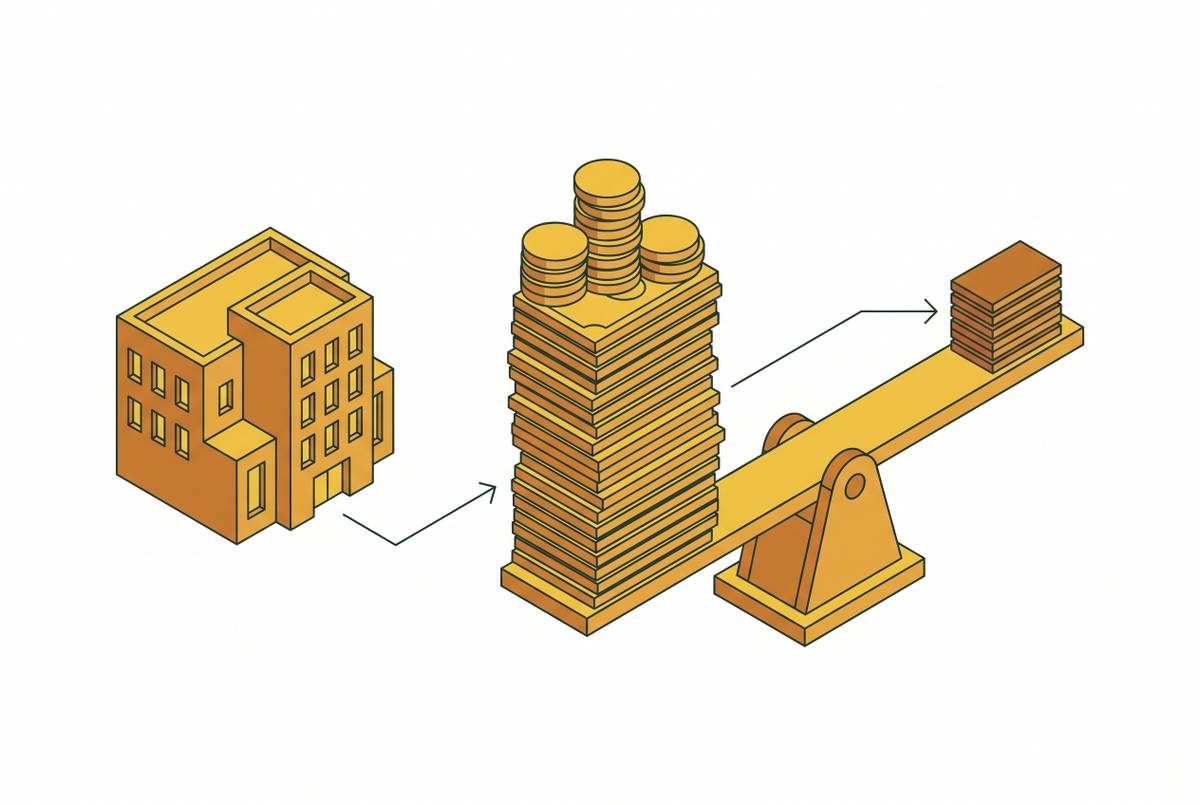
The Tax Amortization Benefit is the present value of the income tax savings a buyer generates by amortizing an acquired intangible asset for tax purposes. When a purchaser can deduct the cost of an intangible over time as a tax expense, the fair market value of that asset rises by the present value of those future savings, a mechanical fact of valuation, not a matter of opinion. Modeled correctly, TAB gives an acquirer a materially more accurate read on what an intangible asset is actually worth, and by extension, what the whole deal is worth.
The number involved isn't trivial. TAB can represent 15 to 25 percent of an intangible asset's fair value, a range wide enough to swing deal economics in a way that appears in the return model, not just the footnotes OPAG IRS. Yet CRE practitioners routinely leave it out. The concept comes out of M&A and intellectual property valuation, so CRE practitioners default to the physical-asset depreciation frameworks they know, and rarely extend their modeling into the intangible layer at all.
That omission has a cost. A buyer who skips TAB is systematically undervaluing the intangible assets in a transaction, and in a negotiation, that's value left on the table, sometimes value the other side already knows is there. What follows covers where TAB applies in CRE, how it's calculated, and why the post-OBBBA tax environment makes modeling it more consequential than ever.
The Section 197 foundation: what governs amortization of acquired intangibles in a national tax code
Section 197 of the tax code allows a deduction for the capitalized cost of an amortizable intangible, and it does something equally important on the other side of the ledger: it prohibits any other method of depreciating or amortizing that same property. One asset, one schedule. A customer list that churns in three years still amortizes over fifteen OPAG IRS FloQast https://www.kiplinger.com/real-estate/real-estate-investing/seismic-shift-in-tax-rules-investors-could-reap-millions. A trade name that could last a generation gets the same fifteen OPAG IRS FloQast.
This applies broadly. Practically, that means the acquirer deducts one-fifteenth of the acquisition cost every year, and it's the rigidity of that schedule, its total predictability, that makes TAB calculable the moment a deal closes OPAG IRS. There's no ambiguity about timing to model around.
A constraint arises early that can undo the whole analysis if missed. Section 197's anti-churning provisions deny amortization for goodwill and similar intangibles that were already held by the seller and weren't amortizable before Section 197 came into effect. The rule exists to stop related parties from manufacturing a fresh tax-amortizable asset out of a paper transaction. For CRE deals involving related parties, or any structure that looks like a recapitalization dressed up as a sale, counsel needs to review the structure before anyone assumes full TAB availability.
There's also a filing mechanic that determines the outcome, not just documents it. Both buyer and seller have to file Form 8594, the Asset Acquisition Statement under Section 1060, allocating the purchase price across seven defined asset classes using the residual method OPAG IRS. That allocation isn't paperwork after the fact. It decides which dollars get the 15-year treatment and which don't, so the negotiation over purchase price allocation is, in effect, a negotiation over the size of the TAB itself OPAG IRS. In a taxable asset acquisition (or a stock acquisition where the buyer makes a §338 election), all identifiable intangible assets and goodwill are amortized over 15 years for tax purposes OPAG IRS.
The TAB formula and how valuers solve its circularity problem
The calculation runs in two steps. First, value the intangible asset on its own, using the discounted present value of after-tax cash flows, with the amortization benefit stripped out entirely. Second, add back the TAB itself, the present value of the tax savings the buyer will realize each year by deducting the amortization.
Simple enough in sequence, except for one problem: the two numbers depend on each other. TAB is a function of the asset's fair value, but the fair value the appraiser is trying to solve for already needs to include the TAB. Each side of the equation needs the other side to already be known.
Valuers handle this circularity one of two ways. Or, more commonly, the analyst uses a closed-form solution known as the Greenfield formula: TAB Factor equals 1 divided by (1 minus the tax rate multiplied by the present value annuity factor), where that annuity factor reflects a dollar received annually over the amortization period, discounted at a rate appropriate to that specific asset. The Greenfield approach skips the iteration entirely and is the method most valuation professionals reach for first.
A simplified example makes the mechanics concrete. Picture an acquirer buying the intangible assets of a regional distribution business for $3.5 million, all allocated to Section 197 property Beancount Kiplinger. That produces an annual amortization deduction of $233,333 Beancount Kiplinger. At a combined federal-and-state effective tax rate of 25 percent, the after-tax cash benefit comes to roughly $58,000 a year, compounding to something in the neighborhood of $875,000 across the full amortization period Beancount Kiplinger. Treat that as illustration only, not a template to paste into a live model: the actual TAB in any deal depends on the discount rate specific to that intangible and the acquirer's own marginal tax rate, both of which move the answer meaningfully. There are two standard solutions. The key inputs the model requires are the tax rate, the discount rate appropriate to the specific intangible, the amortization period of 15 years under Section 197, and the pre-TAB asset value OPAG IRS.
Where TAB applies in CRE, and the critical lessor/lessee distinction that most practitioners get wrong
The exception that trips up more CRE professionals than any other part of this framework. Section 197 explicitly carves out any interest held as a lessor under an existing lease or sublease of real or personal property. So when a buyer acquires an income-producing property, an office building, a retail center, an industrial park, and simply steps into the landlord's role, the portion of the purchase price tied to favorable lease terms doesn't become a Section 197 intangible at all. It gets folded into the basis of the tangible real property instead OPAG IRS.
The consequence runs straight into how GAAP already requires these deals to be booked OPAG IRS SEC EDGAR Kiplinger. Under ASC 805, a CRE acquirer has to identify and separately value above-market and below-market lease intangibles at the property level OPAG IRS. Those get amortized over the remaining lease term, as part of property basis, not over a flat 15 years under Section 197 OPAG IRS. One publicly traded company reported in-place lease assets of $50.5M gross ($25.3M net), above-market lease assets of $4.8M gross ($2.9M net), and below-market lease liabilities of $18.1M gross ($13.8M net), with weighted-average remaining lives of 4.9 years for in-place and below-market leases and 6.0 years for above-market leases (GAAP balance sheet items, not 15-year Section 197 assets), and conflating the two categories inflates a TAB calculation, the present value of future tax savings from deducting annual amortization, where none should exist OPAG IRS SEC EDGAR Kiplinger. The framework that governs a straightforward income-property purchase is, in short, a different animal from the framework that governs an M&A deal built around goodwill and customer relationships.
Where TAB does apply in full is in going-concern acquisitions, deals where the buyer isn't just buying a building but buying an operating business that happens to sit inside one. Hotel acquisitions are the clearest case: brand affiliation agreements, franchise rights, management contracts, guest relationship assets, and goodwill can all qualify as Section 197 intangibles. The same logic extends to self-storage operations, car washes, and single-tenant net-lease properties with an operating business layered on top, where customer lists, non-compete agreements, trade names, and goodwill all trigger the full 15-year amortization treatment OPAG IRS. Any CRE transaction structured as a business acquisition, rather than a pure real estate purchase, pulls the entire TAB framework into play.
How the purchase price gets allocated among goodwill, franchise rights, and lease intangibles then determines both the amortization schedule and the size of the resulting TAB, though pushing too much value into short-life assets like furniture, fixtures, and equipment can create outsized depreciation recapture exposure if the property sells again soon after. The question every acquirer needs to answer before modeling any of this is straightforward: is this a going concern with real, separable intangibles, or a passive income-property play where lease terms just get absorbed into the building's basis? That answer decides that TAB modeling belongs at the center of the underwriting or sits as a footnote.
Asset deals, stock deals, and the §338(h)(10) election: how deal structure determines TAB availability
Deal structure decides more of this than most buyers expect going in. In an asset deal, the acquirer takes a stepped-up tax basis across every asset purchased, marked to fair market value at closing, and because amortization runs off that new, higher basis, the full TAB is available. In a stock deal with no further election, none of that happens. The target entity keeps its historical tax basis in its intangibles, there's no step-up, a deferred tax liability has to get booked in consolidation, and the TAB shrinks dramatically or disappears entirely.
Section 338(h)(10) exists precisely to bridge that gap. When both buyer and seller jointly elect under this provision, a qualified stock purchase gets treated, for tax purposes only, as if it were an asset acquisition. The seller reports the deal as a sale of assets at fair value, and the buyer receives the stepped-up basis in goodwill and every other intangible. The full TAB becomes available inside a transaction that remains, legally, a stock purchase.
That election is never just a legal formality. It's a negotiation over who captures the TAB. For a buyer working a hotel or self-storage acquisition, the choice between pushing for a straight asset deal or negotiating a 338(h)(10) election on a stock purchase belongs at the center of the negotiation from day one. It's a valuation question, and the TAB needs to be quantified before anyone sits down to negotiate it. The anti-churning rules covered earlier apply here too: a related-party transaction dressed up as an asset deal can lose amortization eligibility entirely, so the structure needs review before the TAB gets baked into anyone's model. The negotiation over a §338(h)(10) election is functionally a negotiation over the TAB. The buyer benefits from future amortization deductions, the seller may face higher immediate tax liability, and the TAB's value is typically shared through a purchase price adjustment.
Cost segregation as the tangible-asset complement to TAB analysis in a shared underwriting model
Cost segregation solves a different problem, on the tangible side of the balance sheet. An engineering-based study goes through the acquisition costs, identifies which components qualify as personal property or land improvements rather than structural building components, and reclassifies them into shorter MACRS recovery periods, producing accelerated depreciation on those pieces.
The difference this makes is not subtle. A $3 million office building, depreciated the standard way over 39 years, throws off about $76,923 a year, or roughly $769,230 across a full decade Uncle Kam. Run a cost segregation study on the same building, identify $400,000 in 5-year property and $150,000 in other qualifying improvements, and pair that with the 100% bonus depreciation restored under the OBBBA, and Year 1 deductions jump to roughly $550,000, a different order of magnitude against that same $76,923 baseline OPAG IRS Uncle Kam NAR OBBBA in 2026: Key Business Tax Planning Considerations. It's a different order of magnitude, not an incremental improvement. It's a different order of magnitude in the first year alone.
A formal study of this kind generally pays for itself on buildings purchased or renovated for more than $750,000 Wikipedia NAR. Below that threshold, the engineering fee starts eating too much of the benefit to justify the exercise.
Cost segregation addresses tangible components, the 5-, 7-, and 15-year property OPAG IRS. TAB addresses the intangible layer, the Section 197 goodwill, franchise rights, and customer relationships that show up in going-concern acquisitions OPAG IRS. Treating the two as interchangeable, or assuming a cost segregation study somehow captures the intangible side as well, is a common and costly underwriting mistake. Hotels, operating self-storage facilities, car wash portfolios, and any going-concern deal with real FF&E alongside identifiable intangibles are exactly the property types where both analyses need to run in parallel, and where skipping either one leaves value unclaimed. Under the catch-up mechanism, properties placed in service in a prior year can still benefit, as a Form 3115 filing captures all missed accelerated depreciation as a catch-up deduction in a single tax year under IRC Section 481(a), without amending prior returns OPAG IRS. Cost segregation and TAB interact in the underwriting model.
How the OBBBA changes the math for CRE acquirers modeling depreciation and amortization benefits in 2026
On a $900,000 allocation of short-life property, moving from the old 20 percent rate to the restored 100 percent rate adds $720,000 in additional first-year deductions Engineered Tax Services NAR. For a top-bracket investor working a $5 million property with $2 million in short-life components, the added $1.2 million in first-year deductions translates into roughly $490,000 in federal tax savings in Year 1 alone, capital that's available to redeploy immediately rather than sitting locked up in a depreciation schedule stretched over decades Kiplinger.
The OBBBA restored, permanently this time, the add-back of depreciation, amortization, and depletion when computing Adjusted Taxable Income under Section 163(j), shifting the interest expense limitation back to 30 percent of ATI calculated on an EBITDA basis, rather than the tighter EBIT basis, for tax years starting after December 31, 2024 NAR. That change increases deductible interest expense for leveraged CRE operators, and partially counterbalances the higher depreciation that bonus expensing generates, meaning acquirers should model both effects together. One caveat applies here: real property trades or businesses that already made an irrevocable election to opt out of 163(j) and use ADS depreciation instead don't qualify for bonus depreciation, so those acquirers are working through a different optimization problem entirely. Separately, the OBBBA raised the Section 179 expensing limit to $2.56 million, with a phase-out threshold of $4.09 million, adding another immediate-expensing lever for qualifying assets Kiplinger OBBBA in 2026: Key Business Tax Planning Considerations Depreciation Under OBBBA: 2025 Tax Law Changes Guide - Wiss.
When these factors are put together, the stakes around TAB modeling only get higher. When the tangible side of a deal is throwing off deductions this large in Year 1, an acquirer who still isn't modeling the intangible amortization layer on a going-concern transaction is leaving a second, compounding advantage sitting unclaimed in the pro forma, right alongside the first one. Grant Thornton's analysis shows the OBBBA, signed July 4, 2025, permanently restored 100% bonus depreciation for qualifying property acquired and placed in service after January 19, 2025, reversing a phase-down schedule that would have reduced the benefit to 40% in 2025 and eliminated it by 2027 Engineered Tax Services NAR. The Section 163(j) EBITDA restoration is a key feature of the law.