Interest Coverage Ratio in Commercial Real Estate Lending
Interest coverage ratio measures whether operating income covers debt interest alone.
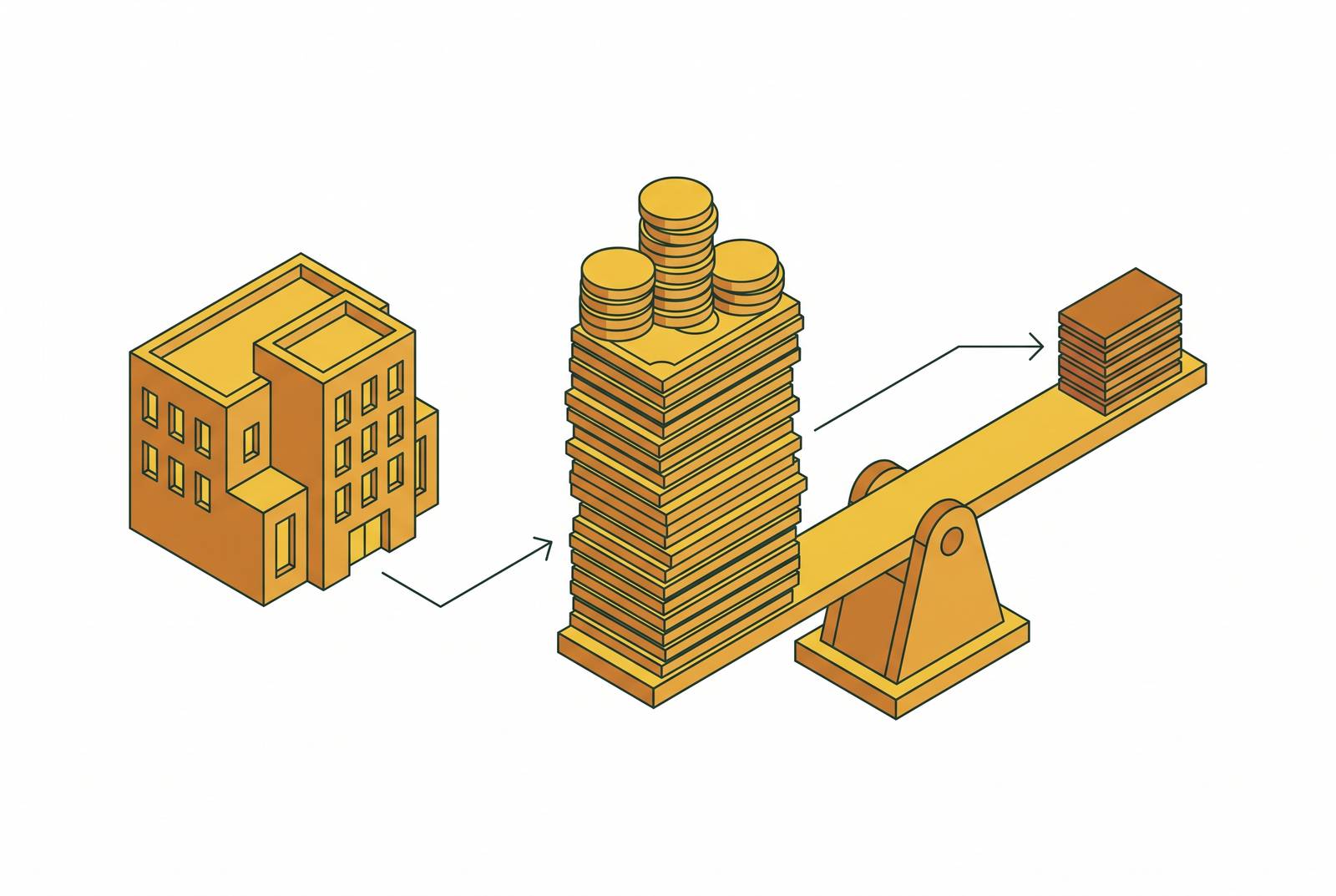
The interest coverage ratio measures whether a property's income can cover the interest bill on its debt, full stop, nothing more.
What the interest coverage ratio measures in CRE
The formula is simple: net operating income, calculated as earnings before interest and taxes, divided by annual interest expense. Some lenders and analysts call it the times interest earned ratio, which is the same math wearing a different name. The numerator is income after operating expenses but before interest and taxes (EBIT), which in a commercial real estate context is effectively net operating income. The denominator is interest only: mortgage interest, interest on a business loan, or any other interest-bearing obligation tied to the asset. Principal repayment never enters the equation, and that exclusion is the entire point of the metric. ICR steps into the foreground specifically where debt is structured as interest-only, and interest-only debt structures are widespread in bridge lending.
Take a property generating $280,000 in EBIT against $140,000 in annual interest expense. Divide one by the other and the ICR comes out to exactly 2.0x, a threshold that appears repeatedly in lender underwriting as the baseline comfort level most lenders want to see on stabilized assets. Below that line, a lender starts asking harder questions.
What the ratio actually tells a lender is narrower than it sounds. ICR is a short-term liquidity signal. It answers one question: can this borrower cover its interest obligation right now, based on current income? It says nothing about whether the borrower can ever pay back the principal, refinance successfully, or survive a rate reset at maturity. That's a different question entirely, and it's the question DSCR is built to answer.
How ICR differs from DSCR
DSCR adds principal repayment to the denominator, while ICR excludes it. That's the whole distinction, but it has outsized consequences for how a deal reads on paper.
A property can post a high ICR (e.g., 4.0x) but a much lower DSCR (e.g., 1.3x) if principal obligations are heavy, meaning ICR alone would overstate financial health in that case CBRE Lending Momentum Index, Q2 2026. That gap reflects something more substantial than a rounding error or a modeling quirk. It's what happens when principal obligations are heavy relative to income, and it means relying on ICR alone in that scenario would badly overstate how financially sound the deal really is CBRE Lending Momentum Index, Q2 2026. A lender who only looked at the 4.0x number and stopped there would be missing the more conservative, and more honest, picture that DSCR provides CBRE Lending Momentum Index, Q2 2026.
DSCR is used for amortizing loans (term loans, commercial real estate mortgages, and SBA lending), where principal is a regular cash outflow throughout the term. ICR, by contrast, is used most naturally in structures where principal isn't amortizing on a schedule at all, structures where it gets refinanced or repaid in a lump sum at maturity instead.
None of this is academic for a sponsor sitting across the table from a lender. Knowing which metric governs a given deal changes how NOI gets presented, how loan terms get structured, and which number a borrower should be optimizing for going into underwriting. A sponsor who builds a pitch deck around a strong ICR when the lender is actually underwriting to DSCR has wasted preparation time and possibly damaged credibility in the process.
Where ICR fits in CRE underwriting
For most of the commercial mortgage market, DSCR is the default. Across property types, multifamily, office, retail, industrial, hotel, and mixed-use alike, most lenders apply DSCR as the primary underwriting standard because most of that debt amortizes. ICR steps into the foreground specifically where debt is structured as interest-only, and that structure is common in one corner of the market in particular: bridge lending. Interest Coverage Ratio plays a significant role in commercial real estate lending.
In interest-only bridge loans of 12 to 36 months, DSCR and ICR are effectively equivalent since there is no principal amortization during the term, but ICR is the cleaner framing. Construction loans follow a similar logic during the build phase. They carry their own interest-only period, and ICR is what governs coverage while the asset is under construction and not yet generating stabilized income.
ICR's role doesn't end at closing, either. Lenders build ICR thresholds directly into loan covenants and test them on a recurring basis throughout the life of the loan, including after origination. That means a property can be making every single payment on time and still trip a covenant default if its ICR slips below the floor written into the loan documents. It's a distinction that catches a lot of sponsors off guard: current on payments and in technical default are not mutually exclusive states.
The measurement window matters here too. For properties or businesses with seasonal revenue swings, lenders will often negotiate ICR covenants on a trailing twelve-month basis rather than a single point-in-time snapshot, specifically to smooth out the volatility and avoid triggering a breach off one weak quarter. Beyond loan monitoring, corporate real estate borrowers and investors lean on ICR more broadly as an ongoing gauge of debt serviceability, independent of any single lender's covenant package.
Lender ICR thresholds and their variation by deal type
Most lenders cite 2.0x as the minimum comfort threshold, and the example of $280,000 in EBIT against $140,000 in annual interest yields exactly that ICR of 2.0x. That number is meant as a floor that should be exceeded by a comfortable margin.
The mechanics of a breach show how fast this can move, faster than the number itself suggests, so walking through them concretely matters. Take that same $140,000 in annual interest, but let NOI slip from $280,000 down to $175,000. The ICR falls to roughly 1.25x, a level that can trigger a formal default notice from the lender even though the borrower hasn't missed a single payment. That's the mechanism every sponsor needs to internalize: coverage ratio deterioration and payment default are separate events, and the ratio can fail well before the cash actually runs out.
The CBRE Lending Momentum Index for Q2 2026 shows the average DSCR on closed loans rose to 1.43 from 1.34 a year earlier, a meaningful upward shift signaling tighter lender standards CBRE Lending Momentum Index, Q2 2026. Minimum DSCR requirements reported across the market generally fall in a range of 1.20x to 1.35x, with the exact figure depending on property type and loan program CBRE Lending Momentum Index, Q2 2026. Multifamily assets, viewed as lower-risk, tend to support lower minimums, while hotels and other properties with volatile revenue streams push lenders toward the higher end of that range.
There's also evidence that underwriting floors are moving upward across the market as a matter of policy. A January 2026 underwriting memo attributed to a top-tier U.S. lender reportedly raised its minimum DSCR threshold from 1.20x to 1.25x for stabilized assets, with transitional deals pushed even further, to 1.30x or higher.
Bridge lending shows how quickly ICR can move even when NOI hasn't changed at all. Bridge loan rates in 2026 have ranged from roughly 7.75% for the strongest borrowers up to roughly 14.5% on the riskier end of the spectrum.
ICR as a live risk metric in the current rate environment
It's the maturity wall sitting directly in front of the market. MBA data shows $875 billion in commercial mortgage maturities is scheduled for 2026 alone, representing 17% of the roughly $5 trillion in commercial mortgage debt currently outstanding, with another $652 billion coming due in 2027.
Loans originated during the 2019–2022 low-rate period are now refinancing at materially higher rates, and even properties with solid NOI face sharply lower ICR on the new debt stack, since the interest expense denominator expands without any change in income. Even a property with perfectly solid NOI, no drop in occupancy, no operational problems whatsoever, can face a sharply lower ICR on its new debt stack simply because the interest expense denominator expanded while income stayed flat. NOI didn't change. The math changed underneath it.
The scale of exposure is considerable. The MBA's broader estimate puts total CRE loan maturities across 2025 and 2026 combined at over $1.3 trillion, with multifamily accounting for roughly one-third of that figure. That concentration matters because multifamily is the property type lenders have historically treated as the safest bet in the portfolio, and now it's sitting at the center of the refinancing wave most exposed to this exact rate-driven ICR compression.
Rates themselves have eased somewhat, but not enough to erase the gap. That's real relief, but it's relief measured against rates that are still well above where many of these maturing loans were originally priced NerdWallet.
Running the arithmetic forward makes the risk concrete. A property originally underwritten at a 2.5x ICR can slip below 1.5x, sometimes lower, purely because of the rate reset that happens at refinancing, with zero deterioration in occupancy or income anywhere in the picture. That's not a hypothetical stress scenario; it's a mechanical outcome of the current cycle, and it's one every sponsor refinancing through this window needs to model explicitly before walking into a lender's office. Lenders are responding accordingly. Over 900 banks still carry commercial real estate concentration above 300% of capital, a exposure level that's pushing tighter underwriting standards and more restrictive covenant structures across the board. ICR covenants specifically are one of the tools lenders lean on to guard against exactly this kind of rate-driven deterioration showing up after the loan has already closed.
How ICR shapes loan sizing
ICR doesn't just get tested after closing. It can cap the loan amount before closing ever happens. Even when loan-to-value would technically support a bigger loan, an ICR that falls below a lender's floor will hold proceeds down, and there's a self-limiting quality to the math: a bigger loan means more interest expense, which pushes ICR down further, which caps proceeds even more. Average commercial LTV came in at 59.6% in Q2 2026, down from 60.8% a year earlier per CBRE, and that tightening leverage environment is a sign lenders are already leaning harder on coverage ratios than on collateral value to decide how much they'll actually lend.
Improving NOI through lease-up, expense reduction, or rent growth directly lifts the numerator, and because interest expense is fixed, even modest NOI gains can move ICR meaningfully. Negotiating on rate matters just as much: commercial mortgage spreads narrowed 21 basis points year over year to 204 basis points in Q2 2026 per CBRE, and that compression means shopping lenders and loan structures pays off in lower borrowing costs, since a 20-basis-point rate reduction alone can materially improve coverage. Loan structure itself is a lever too. Interest-only periods, rate buydowns, and floating-to-fixed conversions all change the annual interest expense figure, which moves ICR at any given point in the loan's life.
None of these levers matter, though, if the underlying numbers going into the lender's model are messy or inconsistent. Sponsors should also negotiate ICR covenant levels, measurement periods (trailing 12 months vs. spot), and cure provisions before closing, rather than after a NOI dip. Lenders expect clean, auditable NOI documentation from borrowers, and the gap between what a sponsor claims NOI to be and what a lender's underwriting team calculates it to be is where deals either die outright or get resized downward. A surprising amount of that gap traces back to process, not disagreement over the numbers themselves. Many underwriting teams still manually re-key figures from operating statements, rent rolls, and tax returns into spreadsheets, and every manual step introduces error risk into the ICR and DSCR calculations the entire loan decision rests on. Purpose-built AI-driven platforms for CRE that extract NOI and interest expense automatically from T-12s and operating statements are changing that dynamic, letting sponsors and brokers model ICR scenarios accurately and quickly, presenting cleaner numbers to lenders and reducing the back-and-forth that delays loan commitments.
The sponsors who come out ahead in this cycle are the ones who treat ICR as something to manage actively rather than a number that shows up on a term sheet after the fact. Understanding the mechanics well enough to stress-test coverage across different rate scenarios before ever sitting down with a lender puts a borrower in a materially stronger negotiating position than one who only encounters the ratio for the first time during underwriting. Given the maturity wall bearing down on the market and the mechanical, rate-driven compression baked into refinancing right now, that kind of preparation is the baseline now. It's the baseline.
Sources
- Commercial Real Estate Loan Rates for 2026 - NerdWallet
- Commercial Real Estate Lending Fundamentals Remain Strong in Q2 2026: CBRE | CBRE
- 2026 DSCR Requirements for CRE Loans
- How US Commercial Lenders Are Replacing Manual Underwriting in 2026
- DSCR Loan Requirements 2026: Minimum Ratios, Credit Rules, and Lender Changes for US Commercial Real Estate - Core Insights Review
- Your commercial real estate loan matures this year. Now what?
- Commercial Real Estate and the Banking Sector | Congress.gov | Library of Congress
- Underwriting Standards Tighten for 2026 Refinancings - CRE Daily