The CRE Tech Stack That Kills Deal Velocity and What Replaces It
Unified platforms eliminate manual data re-entry that slows complex real estate transactions.
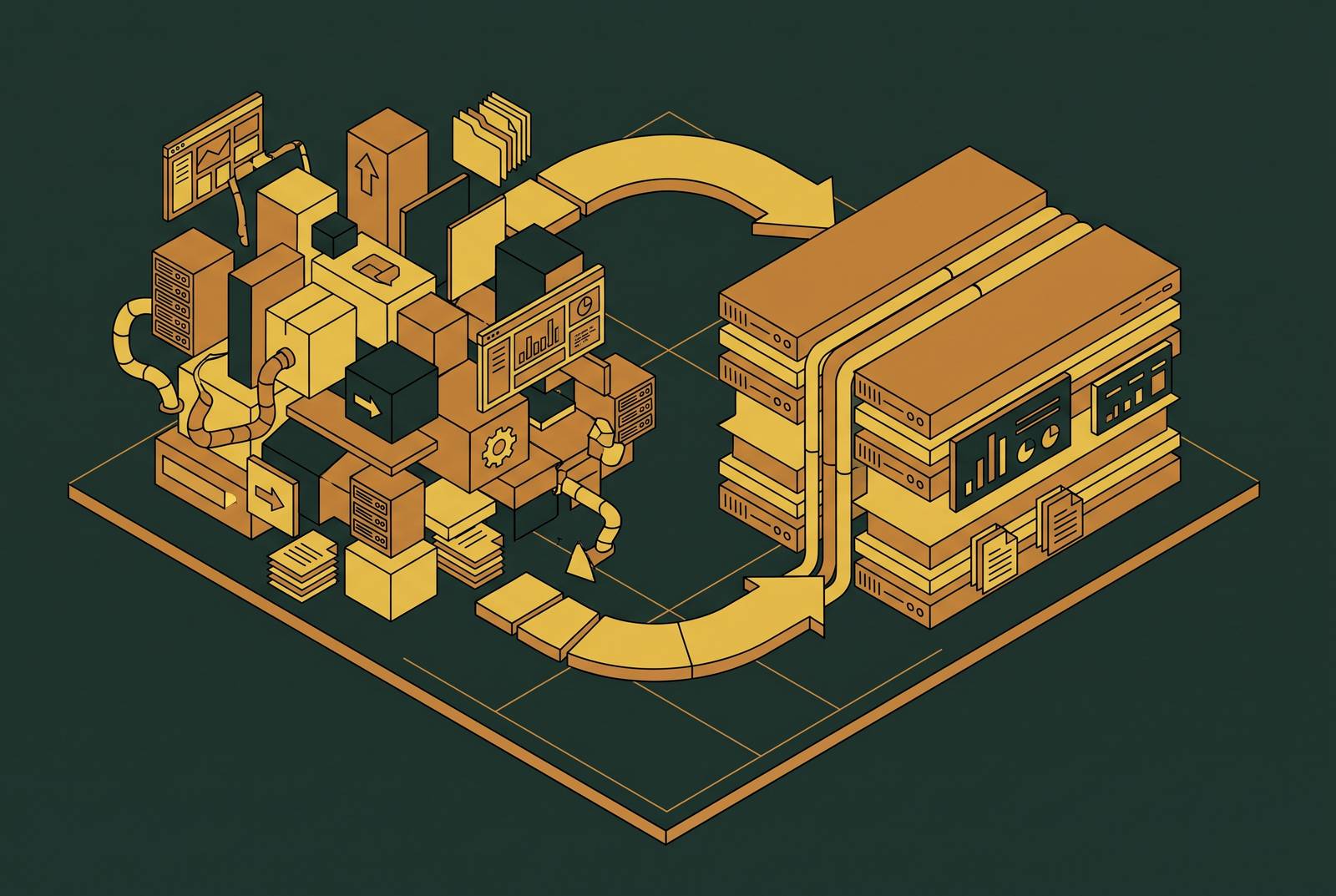
The CRE tech stack that kills deal velocity is a patchwork of disconnected tools that forces teams to locate, reconcile, and re-enter information. Its replacement is a unified, AI-native CRE platform that connects deal sourcing, lender search, underwriting, and closing documentation through shared data and workflows. Removing manual handoffs matters more than automating individual tasks.
Why the conventional CRE tech stack is structurally designed to slow deals down
One operations leader at a mid-sized brokerage counted nine different tools involved in bringing a single listing to market and closing it. Each time the data changed, someone had to update it by hand in several systems. The tools themselves were not necessarily the problem. The information architecture was, because each system held only part of the deal and depended on people to keep that part aligned with everything else.
The 2026 DNA of CRE report found that brokers tend to use roughly seven software tools for prospecting, marketing, and transactions. The same report found that keeping information in sync across those systems was one of the biggest challenges brokerage leaders face in their work. The conventional stack covers five layers, namely deal management, document storage, financial analysis, communications, and market intelligence. Coverage is not the same thing as connection. Each layer has a separate vendor and data model, so the pipeline, documents, lender contacts, and tasks remain divided.
That division produces failures that compound as a deal progresses. Information entered in several places becomes stale as soon as someone updates only one record. Answering a straightforward question about deal status requires checking several tools, while onboarding an analyst requires teaching both the software and the unwritten process connecting it. Friction is therefore built into the architecture.
What the fragmented stack costs in a market where deal volume is accelerating
Accelerating deal volume exposes the limits of that manual coordination. Acquisitions teams face more offering memoranda than their analyst headcount can process at historical per-deal time commitments. The work does not become easier with volume. If each opportunity still requires the same extraction, reconciliation, and re-entry, a larger pipeline creates proportionally more administrative work before anyone can make an investment decision.
The document-to-model bottleneck is especially costly because it consumes analytical capacity without producing analysis. Converting an offering memorandum, rent roll, or T12 into a populated underwriting model can take most of a working day when done manually. That time competes directly with screening additional opportunities. Firms reviewing hundreds of deals per year cannot expand headcount fast enough to preserve that approach as volume increases.
The traditional work of assembling a package and delivering it to a lender list is partially automated on both sides of the transaction. Manual assembly now competes with a different operating process. Lenders that receive AI-structured packages, with data already extracted from documents into the formats they expect, can move those deals through the underwriting queue faster. A late package therefore loses ground both because it arrives later and because other packages take less work to assess.
Where the drag actually lives in the four manual handoffs that kill deal velocity
The first handoff is deal intake to pipeline. A deal arrives by email, and someone manually creates a CRM or deal-tracker entry. The email and pipeline record then evolve separately. If nobody logs the deal, it may never reach pipeline review at all. This is the first break in continuity, before document analysis or underwriting begins.
The second handoff is document ingestion to underwriting model. An analyst receives an OM, rent roll, and T12, then reads, extracts, and re-keys the financial data into a model. The task consumes analyst hours without generating insight, and its accuracy depends on sustained attention through repetitive work. The documents contain the information, but the model cannot use it until a person transfers it.
The third handoff is underwriting model to deal memo or loan package. Once the model is complete, an analyst rebuilds its conclusions in an offering memorandum, investment committee memo, or lender submission. Figures already captured elsewhere are entered again into templates. The additional effort goes into presentation rather than analytical depth, extending the preparation cycle after the substantive underwriting work is done.
The fourth handoff is internal records to lender or investor outreach. Contact information, deal status, and lender preferences sit in different tools, requiring a broker to consult the CRM, a preference spreadsheet, and often personal email history. This work falls to the broker, taking time away from prospecting and building relationships.
Why adoption of point solutions keeps failing even when the tools are capable
A document extractor may perform well while leaving the analyst responsible for moving its output into a model. A CRM may organize contacts without connecting them to current deal assumptions or lender preferences. Buying another tool can make one step better while leaving people with the burden of keeping it in sync with the rest.
That burden also explains why adoption deteriorates. When a new platform cannot be populated from existing data without manual migration, teams keep the old and new systems running in parallel. Attention splits, and the new system is often abandoned. Poor data quality then becomes both a cause and a consequence of inconsistent usage, because an incomplete platform gives people less reason to rely on it.
Workflow inconsistency creates a similar problem inside otherwise capable software. If one analyst completes environmental diligence early and another postpones it until closing, a poorly configured platform records that inconsistency in the process. Analyst resistance adds another layer, particularly when Excel fluency is central to perceived professional value. Trust cannot be assumed at deployment either. CRE professionals may accept AI for extraction, research summaries, and memo drafting while remaining skeptical of its role in high-stakes financial decisions, so treating those uses as interchangeable can accelerate rejection.
What software lets CRE teams handle lender search, underwriting, and closing docs without switching tools?
There is nothing to reconcile when prospecting, deal management, document analysis, underwriting, and outreach operate from the same dataset. That is the defining proposition of a unified, AI-native CRE platform. The information does not leave the deal workflow.
The earlier handoffs provide a concrete test of that architecture. At intake, an analyst can forward a broker email into a workflow that reads the OM and extracts assumptions. The system validates those assumptions against market data, builds the model, and returns scored output without requiring spreadsheet transcription. The human defines strategy and makes the capital decision.
The same continuity extends from underwriting into documentation and outreach. Memo generation and package assembly use information already held in the workflow, while lender matching connects the deal with relevant lender preferences. Property information also flows into listing materials and distribution channels. These functions remove the need to rebuild a deal’s financial story or assemble its targeting context across separate tools.
The distinction is therefore not whether a product has an AI feature. It is whether that feature acts within a connected process or produces another output someone must transfer. For brokers, connecting document assembly and lender targeting reduces manual coordination enough to change which deal sizes and volumes are economical to pursue.
How purpose-built CRE AI differs from general-purpose AI retrofitted to real estate workflows
General-purpose AI can write text and process documents while leaving people to check the information behind them. If its output is disconnected from authoritative CRE data, an analyst still has to validate assumptions elsewhere. A faster draft does not establish whether the underlying lender preferences, market comparisons, or financial assumptions are current and usable.
Purpose-built CRE AI combines its processing capabilities with CRE-specific training and connections to real-time industry data. Relevant inputs include lender preferences, market comps, DSCR and LTV thresholds, and submarket vacancy trends. Those inputs give extracted assumptions a benchmark. Without them, the system can reproduce information from a document but leave the most consequential verification work untouched.
Agents built for lender search, memo generation, financial spreading, or deal scoring embed asset class conventions, loan structure norms, document formats, and counterparty relationship patterns. These details shape how well the output fits the deal. A generic model’s ability to write fluently does not by itself establish that fit or remove the need for further review.
BCG’s 2026 analysis found that fragmented data landscapes and asset-centric operating models are major structural barriers to AI adoption in real estate. The finding puts the data foundation at the center of the decision, rather than treating it as preparation for the more interesting AI purchase. Stale or unverified inputs undermine either architecture. Purpose-built technology must therefore be assessed by the connection between its domain logic, its data, and its workflow.
What the transition from fragmented stack to unified platform requires in practice
For a firm making this transition, consolidation should begin with deal management because poorly structured deal management creates downstream data problems. The practical target is a single deal management platform as the system of record, supported by financial analysis and market intelligence. This requires establishing where deal information lives and removing manual coordination wherever the unified workflow can replace it.
Data silos, differences in the order of diligence steps, and resistance from analysts remain implementation problems after a contract is signed. Configuring the platform around CRE workflows and the team’s working practices addresses the same conditions that previously drove staff back to spreadsheets, email, and parallel systems.
Several standalone categories become redundant as their functions enter the shared workflow. Embedded AI handles lease abstraction, operations platforms absorb CRM functions, and deal workflows incorporate marketing automation. AI lender matching replaces manual lender search. Select a platform whose functions use the same deal information.
Enterprise security is also a non-negotiable selection requirement. Rent rolls, operating statements, lender terms, and borrower financials are among a CRE firm’s most sensitive records. Consolidating them concentrates responsibility in the chosen system. A platform that cannot demonstrate enterprise-grade data handling cannot serve as the system of record for the deal lifecycle, regardless of how quickly it processes documents.
What firms that have moved to unified AI workflows are doing differently from those still managing the stack
Firms operating unified AI workflows are reallocating analyst time from extraction and re-entry to exception review, structure analysis, and decision support. Analyst output per head and deal velocity show in practice what changes when the workflow is connected.
Bellwether Enterprise provides a concrete example of that reallocation. Its integration of AI into operating statement and rent roll processing substantially reduced time spent on those tasks, freeing analyst capacity for higher-order deal work across a large integrated workflow. Broker economics are changing for the same reason. Teams that automate package assembly and lender targeting can profitably pursue smaller deals that previously required too much labor, while manual teams remain focused on the same larger opportunities with the same headcount.
The decision is becoming more immediate as deal volume accelerates, institutional LP scrutiny of underwriting processes rises, and automation expands on both the buy and lend sides. Firms that moved from pilots to full deployment in 2024 and 2025 are executing faster, running leaner teams, and making fewer assumption errors than those still evaluating. The window for transition remains open, but it is narrowing. CRE is entering an execution phase in which the advantage comes from operating a connected workflow.