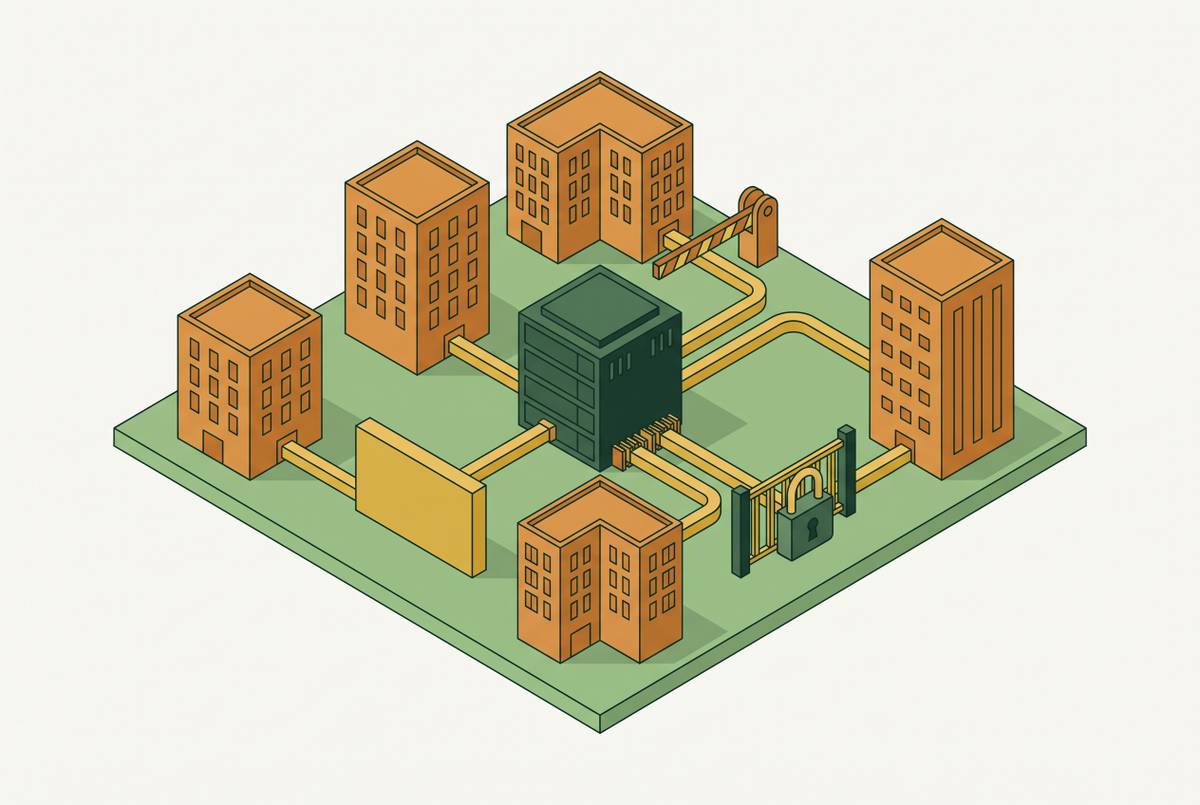
CRE PropTech Consolidation and the Rise of Unified Platforms
Unified platforms consolidate fragmented CRE software into single systems.
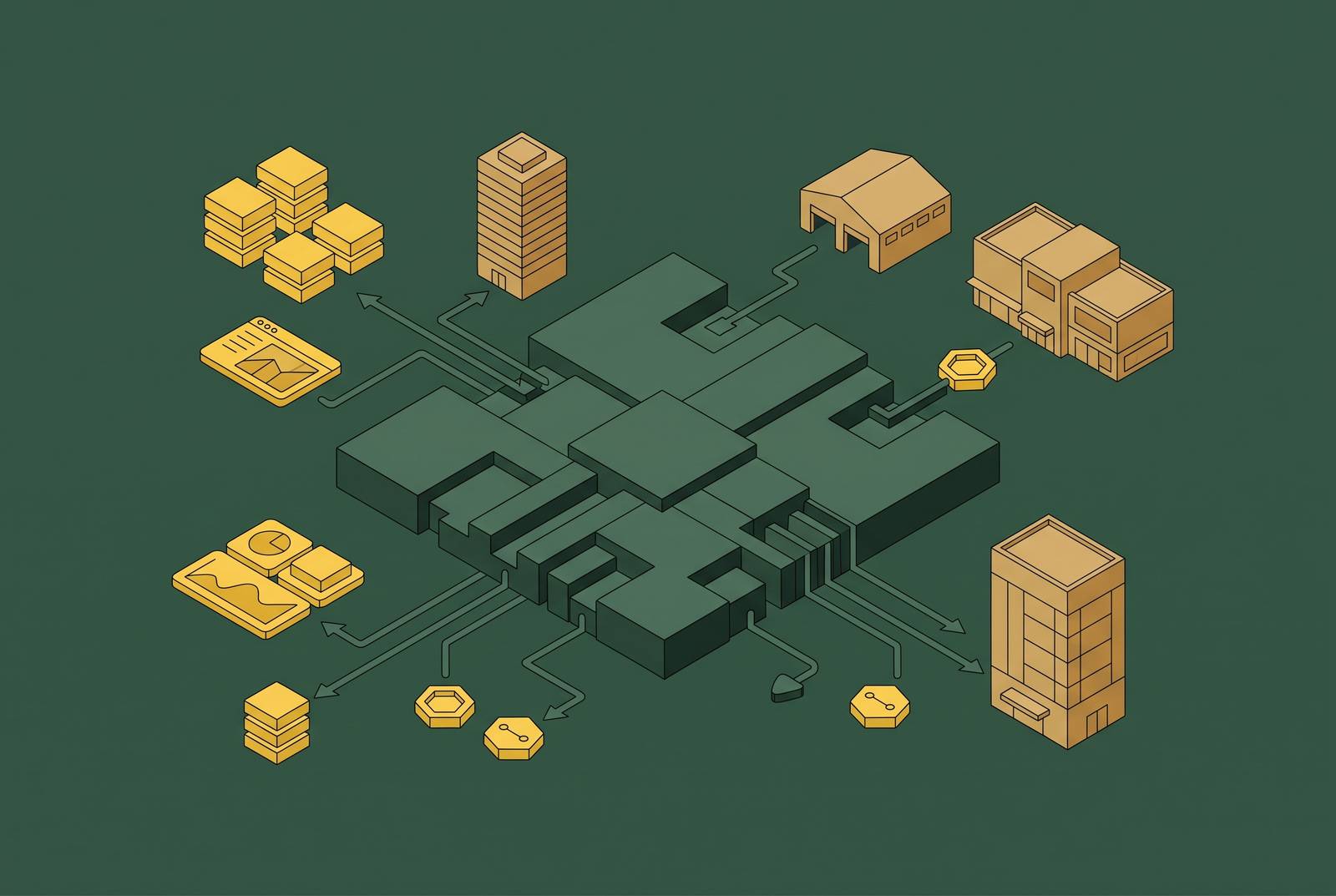
CRE PropTech spending climbed from under $2 billion a year in the early 2010s to more than $30 billion at its peak, and nearly all of it went toward solving one narrow problem at a time. A CRM for contacts. Separate software for building offering memorandums. A distribution platform for listings. An email tool for investor outreach. Spreadsheets for commissions. Each product did its one job well and had nothing to say to the others. That's the fragmentation the industry built, and it's the fragmentation the industry is now spending a second fortune to undo.
The 2026 DNA of CRE report puts a number on the result: brokers typically run about seven separate software tools just to manage prospecting, marketing, and transactions. Buildout's work on the fragmentation problem illustrates what that costs in practice. The same property record gets entered multiple times across different systems, into the CRM, into the marketing platform, and again at closing. Synatic's research on the ownership side echoes the same picture: most CRE firms run siloed systems within individual buildings and across their portfolios, with no single view of what's actually happening across their assets.
That paradox deserves sitting with. CRE firms have more software today than at any point in the industry's history, and they are not obviously more efficient for it. The stack became the problem it was bought to solve. The rest of this piece argues for what's replacing it, and makes the case for why the replacement wins, not why it might.
The scale of the industry that makes this fragmentation expensive to sustain
Commercial real estate was valued at $7.7 trillion in 2025 and is projected to reach $10.46 trillion by 2035. An asset class of that size can't treat workflow friction as a rounding error. A small percentage loss compounds into a very large absolute number, and at this scale, "small percentage" still means billions.
The technology layer on top of that asset class is growing even faster. The global CRE technology market was worth $11.4 billion in 2022 and is expected to hit $34.6 billion by 2033, a 14.2% compound annual growth rate. Lending volume tells the same story from a different angle: the Mortgage Bankers Association recorded $498 billion in total CRE lending for 2024, up 16% year-over-year. Every one of those deals passes through the fragmented stack multiple times, from origination to underwriting to closing.
The math here isn't subtle. When the asset class is measured in the trillions and the technology layer on top of it compounds at double digits, friction that used to be a single firm's headache becomes a drag the whole industry carries. Nobody budgets for multi-tool re-entry as a line item, but it shows up anyway, buried in headcount and closing delays.
Why capital is now concentrating around platforms rather than point solutions
Investors have noticed, and they've stopped spreading bets evenly. More than $11.2 billion of 2025 PropTech funding went into deals north of $100 million, and just 31 companies captured over 72% of all the capital invested that year. Point solutions are losing the argument, and the money is the evidence.
What separates those 31 companies from everyone else is a broader set of advantages that no single feature captures. It's a data moat and a distribution channel that a narrow tool has no path to replicate. A larger platform spreads its technology cost over more deals and builds integrated capabilities a standalone product can't match on its own, no matter how well it's designed.
The Compass and Anywhere merger is a visible version of this logic. The combined entity oversees roughly 340,000 agents across multiple global brands, joining brokerage scale with a digital platform to reshape its position in the market, according to The Boss Magazine. Industry observers broadly expect accelerated M&A as capital concentrates, AI exposes inefficiencies, and platforms converge. Across the industry, the defining move this year is widely characterized as a shift from point solutions to unified platforms, and from AI bolted on as a feature to AI as the underlying architecture.
Private credit is helping fund the consolidation. Alternative debt sources have grown their share of domestic CRE lending volume meaningfully above historical averages. That capital shows up exactly when platforms need it to acquire and rebuild the point solutions they're absorbing, and it's a big part of why this consolidation is happening now rather than in five years.
What a unified platform actually looks like when built around the deal lifecycle
The architectural shift is simple to describe, even if it's hard to build. Instead of software organized around a department or a task, a unified CRE platform organizes around the property and the deal itself, so data entered at prospecting is still there, unchanged and unreentered, by the time the deal closes.
In practice, that means operational, financial, and building data centralized across a whole portfolio instead of siloed by asset. Scheduling, reporting, invoicing, and lease abstraction run on their own instead of by hand. Dashboards combine property management, accounting, and building sensor data in real time, and portfolio-level reporting works across scattered assets without someone stitching spreadsheets together at 11pm before a board meeting. One data layer connects ERP, CRM, and property management systems, instead of three separate systems politely exchanging files through an API that breaks every time someone renames a field.
Lending and underwriting show this clearly. Analysis of the 2026 lending technology landscape shows that the strongest systems connect loan onboarding, document digitization, financial spreading, servicing data, and reporting into one controlled workflow, rather than passing a loan file between four different tools. Accounting is another proof point: ASC 842 and IFRS 16 require detailed lease tracking, and Platforms integrating leasing, accounting, and financial reporting cut down on manual error and make audits far less painful. ESG reporting is becoming the next test case, since energy usage and carbon emissions data now need to flow into financial reports alongside the usual operational metrics. A unified platform treats that as one more data stream. A fragmented one needs a separate compliance tool bolted on, and a separate person to reconcile it by hand.
None of this is the same as buying several point solutions and having their vendors agree to integrate. A stack of tools connected through partnership APIs still has separate ownership boundaries, separate update logic, and separate points of failure. Calling that "unified" is a marketing choice, not an architectural one, and a firm signing a contract should not confuse the two.
Where AI agents fit, and why they require unified data to deliver on their promise
An AI agent, in this context, is software that reasons, plans, and carries out a multi-step workflow toward a goal on its own. It's not a single-task macro. Think of something closer to a junior analyst who doesn't need to be walked through every step, and that distinction changes what the software needs underneath it to actually function.
Agents are already doing real work in CRE. On the sourcing side, they scan listing platforms and public records daily, match properties against a firm's stated investment criteria, run a first pass of underwriting, and surface the handful worth a human's attention. In cash flow modeling, an agent reads a rent roll, a set of leases, and an operating statement, pulls out the relevant inputs, and builds a full model in a firm's own template. In document processing, agents extract structured data out of unstructured loan files, operating statements, and lease abstracts. In building operations, they schedule preventive maintenance on HVAC systems, plumbing, and elevators before deferred upkeep turns into an expensive breakdown.
Vertical AI, built specifically around lease data and accounting systems, is broadly understood to deliver better results than general-purpose AI retrofitted for real estate. That's the difference between a tool that already knows what a rent roll is and one that has to be taught, deal by deal, what it's looking at.
Every one of those use cases depends on the same precondition: the data has to be connected. An agent asked to reason across seven disconnected systems runs into the exact blind spots that used to slow down the human analyst switching between those same seven screens. Fragmented inputs don't just slow an agent down. They cap what it can ever do, no matter how good the underlying model is, and no amount of prompt engineering fixes a missing data pipe.
Why 92% of CRE teams are piloting AI but only 5% have achieved most of their goals
JLL's global survey found that the share of CRE companies running AI pilots jumped from 5% to 92% in three years, about as fast an adoption curve as any technology has managed in this industry. Only 5% of teams say they've achieved most of what they set out to do. That gap, not the adoption number, is the real story.
The failure traces to an architecture problem wearing an AI costume, not a model problem. JLL's 2025 Tech Survey points to a clear pattern: the firms hitting their goals run document parsing, financial modeling, and risk analysis as one connected workflow. The firms falling short bolted an AI feature onto an existing point solution and called it transformation.
So the question a firm should ask before signing another AI vendor contract is how well the system fits its actual workflow, not which model performs best in a demo. It's whether the data and workflow infrastructure underneath even supports AI reasoning in the first place. Buy the agent before fixing the plumbing, and the agent inherits every blind spot the plumbing already had. That's the wrong order, and it's the order most firms are still choosing.
How the CRE lending and capital markets stack is consolidating around the same logic
Lending volume is picking back up, and that recovery is putting real pressure on underwriting throughput. CBRE's Lending Momentum Index rose 112% year-over-year in the third quarter of 2025, reflecting a significant rebound in lending activity. CMBS issuance reached $115.2 billion through November 2025, a notably strong result by recent historical standards. More deals are moving through the same pipes at once, and the pipes haven't gotten wider.
Regulatory scrutiny is tightening on top of that volume. Over 900 banks now carry CRE exposure above 300% of their capital, and tighter underwriting standards mean more documentation and more sophisticated risk analysis per deal. Manual review can't keep pace with higher volume and a heavier documentation burden arriving at once. Smaller community lenders are widely observed to be lagging in AI adoption, and that gap is a real strategic opening for whichever lenders and borrowers move first.
A handful of platforms show what this consolidation looks like in practice. Lev, a CRE-specific AI and data platform where sponsors and brokers run deals end-to-end, is one example of how that unified architecture is being applied on the capital markets side. Some institutional platforms are priced above $25,000 a year, targeting sophisticated deal and portfolio management needs. nCino targets the institutional tier at a similar price point. Yardi Debt Manager occupies the same institutional tier and price range. Built Technologies specializes in construction lending, with pricing structured around individual projects. Clik.ai, focused on loan file digitization and intake, has built meaningful adoption among larger domestic lenders.
What all of them are converging toward is the same idea driving the rest of the industry: loan onboarding, document digitization, financial spreading, servicing data, and reporting living in one controlled workflow instead of five disconnected ones. On the sponsor and broker side, the same logic applies to preparing loan packages, running lender searches, and producing deal documentation. Platforms built specifically for CRE capital markets work are, in effect, the sponsor-side mirror of what institutional lenders are already building for themselves.
What CRE professionals should look for when evaluating whether a platform is genuinely unified or just integrated
The distinction that matters is simple to state and easy to miss in a sales demo. Genuine unification means one data layer, where information entered at the start of a workflow is automatically there at the end of it. Integration means two vendors agreed to pass some data back and forth, while the systems underneath, and who owns what, stay separate. Most vendors will call the second thing the first thing, so the burden falls on the buyer to ask harder questions.
Does property data entered during prospecting show up automatically at closing, or does someone still have to retype it? Is the AI reasoning over live deal data, or over a static export somebody pulled from another system last week? Can an agent act across sourcing, underwriting, documentation, and lender matching, or is it boxed into just one stage? Is the security model built specifically for sensitive deal data, or is it a general enterprise tool adapted after the fact? Does the platform pull in real-time market data on its own, or does a person still have to import it by hand? A vendor that can't answer all five without qualifying the answer probably isn't unified, whatever the pitch deck says.
The architecture decision comes first, and the productivity gain follows from it, not the other way around. No amount of AI feature-marketing changes that order. Platforms built from the ground up around deal workflows, real-time CRE data, and purpose-built agents for tasks like lender search, deal memo production, and financial spreading show where this is heading: apps, agents, and data living on one platform, rather than a collection of point solutions politely talking to each other through a partnership API.
The distance between those firms and everyone still running a seven-tool stack held together by copy and paste will keep widening without deliberate effort to close it. It's going to widen, and it's going to widen fast.